2/22/2012

Narrows Creek Restoration

Before spring arrives, I suppose I should I report on some ongoing changes which ought to be of interest to our fishing guests. As I have mentioned in earlier posts, for several years we have been after Montana Fish, Wildlife, and Parks to restore Elk Lake's Grayling population.

Afluvial Artic Grayling (lake dwelling) are native to the Red Rock Valley. They are native to Elk Lake. Most likely the 'originals' found their way from Upper Red Rock Lake, through Swan Lake, up Elk Springs Creek and into Elk Lake. However, many years ago, the decision was made to raise the level of Elk Lake a few feet by damming the lake's outlet on the south end. As a result, the lake became a sealed water source. While a few streams ran in, nothing ran out (above ground).

Elk Lake is well-known for producing fat, fiesty fish. The lake's fresh water shrimp and leaches produce amazing feed for its inhabitants. Unlike Hidden Lake, whose Rainbows need time each spring to recover from their lean winter, Elk Lake's trout are footballs year round.

But, as so often happens, over time things began to go wrong. One by one Elk Lake lost its spawning streams. First Limestone Creek - probably due to some heavy runoff which filled the channel with debris and eventually forced the water underground before it reached the lake. Then along came the recent dry years. Combine lower water flows with a less-than-helpful fish biologist (see an earlier post for those details), and Narrows Creek became seasonal at best. As naturally happens, debris and grass began to fill the empty channel. Spawning fish were left with little bitty Spring Creek - not a hospitable spawning stream although the trout, at least, tried to make it work.

As a result, over time, the Grayling population died out. Yet, with all the push to return native fish to native habitat, we wondered why someone was not working to return Grayling to Elk Lake. So. . .we started to ask questions. Then we started to make suggestions. And, eventually, we came to see the FWP's interests were similar to ours. These things just take time!
Narrows Creek's time finally came at the end of 2011. If you read that post I mentioned earlier, you know the first step was to begin reintroduing Grayling to the lake. The first year (nearly 3 years ago now), several thousand Grayling fingerlings were planted in the lake. However, while these fish were genetically the same as the original lake residents, the goal was to hatch Grayling here - at Elk Lake. Thus, when they reached spawning age, their natural instinct would drive them back to their birthplace.

Funding is always an issue - especially when you're talking government project. So when we heard this would proceed in at least two stages, we were not surprised. What did surprise us a bit was the decision to develop Spring Creek first. However, seeing the near-to-finished product, I am quite certain no one will complain. It is beautiful!

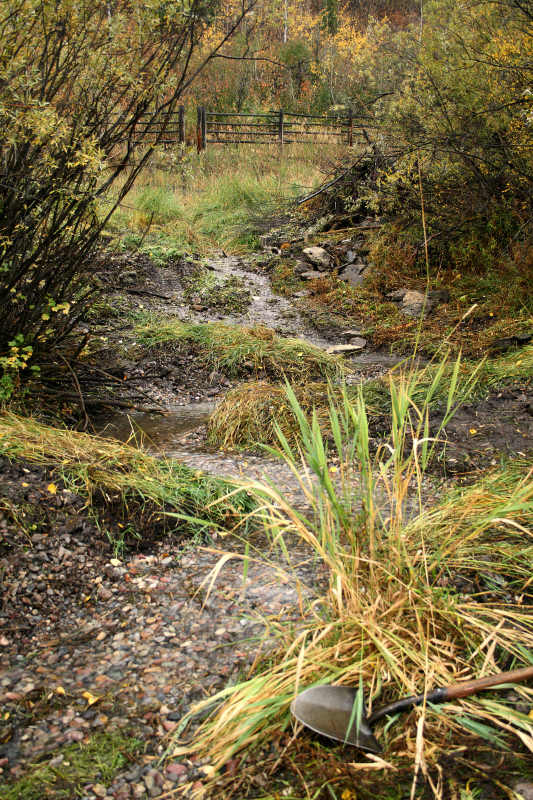
Five photos up is a picture of Narrow's Creek running full bore last spring. As you can see, the creek lives up to its name. From the pond (top photo) down, the creek is narrow with steep banks and grassy sides. While it used to sport a rocky bottom important to spawning fish, debris and dirt have eroded away at the things fish need most. On the other hand, Spring Creek has never been a good spawning stream. For one, it is very shallow. For two, it was 'never' (at least that I can determine) a developed creek. The spring was originally developed as the resort's water source. Once we had a well, the spring was simply allowed to run free and find its own way down to the lake. Over the years that produced a stream bed (of sorts), but it would have taken many more generations (and a lot more water) to have ever built this little stream into something hospitable to a spawning Grayling or Trout.

Yet, as you can see sevearl of the pictures above, the creek is taking on a whole new look. From something which looked similar to Narrows Creek as shown above (but with less water flow and shallower), Spring Creek is being turned into a work of art. So dedicated was its designer (an architect) and its developers, they not only opened up the creek and added gravel, they even paid attention to the 'little' things so important to a 'natural' spawning stream - logs, stumps, grasses, and even the creek bottom did not escape their attentions.

In other words, the Trout (and, hopefully, Grayling) not only received a new spawning stream, but resort guests received a beautiful new water feature! I can imagine it being a favorite spot in years to come - especially as those fish start spawning in its welcoming waters.

If I ever doubted the seriousness with which the FWP took our request (and their own decision to reintroduce Grayling and conditions favorable to their future survival), all doubts were removed as I watched the efforts which went into re-creating this simple stream. They even carefully designed riffles, such an important part of good spawning habitat (although I warned them I had a resident riffle-redesigner in residence :-)

Yet, lest you think this project consisted of merely planting a few fish and rebuilding an existing stream - well, it took a LOT more than anyone will ever see. In fact, some of you may have wondered about what I said earlier (about Spring Creek's low flow). The FWP certainly thought about this. What is the use of rebuilding a stream (outside of its athestic beauty) if it does not offer a spring runoff (apparently the 'trigger' to get Grayling into the spawning mood) and it does not have enough water volume? Well, the second phase began with the arrival of heavy equipment and a truck load of pipe.

The first couple of days (during this phase) things were pretty quiet at the resort. All the work was focused on installing a headbox at the outlet of the pond about 1/4 mile up Narrows Creek from the lodge. The headbox allows the FWP to direct the water in one of three directions. The water can run right through the headbox and down the creek (as it is doing right now)

Or, it can be directed down the new pipeline and either into Narrows Creek (below where the creek was virtually sinking out of sight the last few years) or all sent into Spring Creek for spawning habitat.

So, once the headgate was installed, the construction crew dug a trench down the slope all the way to a new outlet branch on Spring Creek. This pipe, then, will carry the water down to where it is needed for spawning habitat.

As I've already mentioned, this is a multi-step project. The first part was to introduce the fish. The second was to provide them with the best possible spawning grounds as quickly as possible. To facilitate this, the decision was made to combine Narrows Creek (whose flow has fluctuated greatly from year to year of late) with Spring Creek (whose flow has remained steady for many years). The combined flows (even if Narrows Creek has a low year) is considered adequate for the fishes' spawning needs. However, stage three does contain plans for restoring Narrows Creek. Thus, near where the pipe goes under the road, there is a valve which allows the FWP to direct all the flow to Spring Creek, all the flow to Narrows Creek or split the flow between the two streams.

And, as a final step in guaranteeing the successful reintroduction of Grayling into Elk Lake, the FWP installed a simple headgate near where Spring Creek comes out of the ground. This headgate will allow them to properly flood their fry incubators and, hopefully, produce many more youngsters to repopulate the lake - helping speed the Grayling's restoration.

All this for a fish. While I'm not big on government programs, I've had reason many times to scratch my head about their decisions, and I'm not even a big fisherman (and, for the record, this was not my idea :-); I must admit, this project has piqued my interst. The work which they have done is beautiful. In fact, the only thing I expect most resort guests will ever notice (outside of a beautiful creek flowing on the south side of the resort), is the headgate on Spring Creek. And, even this is non-intrusive. Thus, I hope it all works - but even if it doesn't, Elk Lake guests have gained a beautiful new addition to the resort's grounds, and I have gained new respect for those men and women who are fish-lovers at heart - to the point of creatively designing the best habitat they can put together, and all for a simple fish whose ancestors used to call Elk Lake home.

Lady of the Lake

2/14/2012

A Few More Highlights of 2011

Before we are too far into the new year, I wanted to pause a moment to reflect on a few striking things which did not make it into blog posts in 2011. Some of them I saw and recorded, others I saw and could not (or did not) record. For those, well, you'll just have to take my word for it.

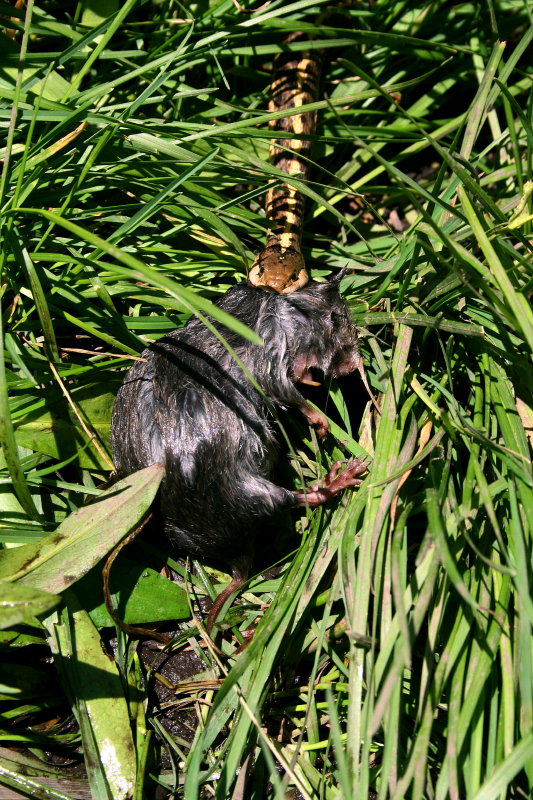
Near our back door is a footbridge crossing Narrows Creek. While this creek has not run every year we have lived here, this past year was a banner one - at least for this little creek. Thus, one day in late July as I walked across the bridge I heard a commotion. Those of you who know me well, know I am fairly well endowed with curiosity. So, of course, I sought the source of the noise.

What I found was a little sickening - a little saddening - yet none the less fascinating! Now understand. I am not a mouse lover or a snake lover. I have never been one to call either a 'pet'. My son, on the other hand, will carry around snakes and frogs and. . .well, just about anything he can get his hands on. While I don't fear either, I don't care for either. Nonetheless, I had to feel sorry for the mouse.

Due to Elk Lake's elevation, the only snakes we find in our backyard are Garter Snakes. These snakes can 'bite' (obviously they have some sort of teeth or this mouse would not have stuck around for the experience), but not hard enough to hurt (at least according to my son). Thankfully (again, for my son's sake), they are not poisonous.

I have always assumed these snakes subsisted on bugs and such. At least I had never seen such a stunt - and assumed they would have no way to kill larger prey anyway. Well, I learned how it's done. First you drag your catch through the water and drown it (this mouse was not quite done in, as the last picture reveals, but it was not far from it). This was the commotion I heard.

At the time I snapped these photos, I am not sure if the snake was just trying to get away from me (and all the other curious faces who quickly gathered around), or if it was just heading off to await the mouse's eminent demise. One way or the other, I learned an interesting science lesson - and saw a sight I will never forget!

Another amazing sight seen TWICE this summer (so, you are right in thinking I have no excuse for not capturing it), left me so speechless I literally failed to remember I had a camera until it was too late. So, what could have been so amazing? A Trumpeter Swan chasing a Canadian Goose! I've always thought of these birds as similar in size. They are NOT! In fact, it was something like watching two stunt pilots - one in a Cessna and one in a Boeing 747. Although I have seen more acrobatic flying from raptors 'fighting' overhead, I have never seen anything to compare. All I can assume is one stupid goose decided it needed to be in a spot where that particular swan had staked its claim.

And, perhaps most amazing of all - this happened over by Widgeon Pond. I only 'happened' to see this TWICE while driving past. Since they carried on for long moments (not one pass but many), I have to wonder who else saw them? Certainly, I could not have been privy to the only times they clashed.

Up above Elk Lake are some small box (ish) canyons. I call them box (ish) because they are not true box canyons which only have one way out. However their sides are steep - and they are not the typical topography found around Elk Lake. For this reason I have found myself drawn back to them time and again.

The 'walls' of these small canyons are made up of dirt and rocks and heavy brushy growth. To make the area even more interesting, one day I stumbled across the rock pictured above. Unlike all the other rocks around, it is covered with 'holes'. When I first saw it, I thought they were old swallow nests. However, one morning I decided to take a closer look. Lo and behold - this rock is natural! Amazing! Where did it come from? Why is it so different? What created the 'holes' on its face?

My regular readers know we had a small fire up near Hidden Lake late last summer. Thankfully the USFS decided to put it out. However, a few days later, we had another scare. We looked out our window to see a red sky and billowing smoke. Where is the fire (for obviously there was a fire somewhere)? How close? Were we in danger? A few phone calls later we learned the strong winds had blown in smoke from some fires in Idaho. Thank God. We slept easier knowing the threat which looked so close was really far away.

Winter 2010-2011 was VERY different from winter 2011-2012. For one - it snowed and snowed and snowed. Unlike this year, we couldn't seem to find the 'off' switch. As a result, I was finding snow in the oddest places - and late late late into the summer. We found these substantial drifts on a north facing slope in late July. They were many feet deep, even after over one month of very warm summer weather. I kinda doubt we'll find anything like that this July!

The final 'highlight' to make my list for 2011 was something I've seen before, something which always strikes me as beautiful, yet something I have never managed to capture on film. Animals crossing a river has a wild yet graceful yet unspeakably beautiful essence to it. Particularly when they happen to be crossing a large and beautiful river like the Madison. So, when I once again enjoyed watching a pair of deer wading the river this past spring, I kicked myself for not having a camera. Oh well - I can only hope for another opportunity with a camera close at hand.

Even as I say good-bye to another year, I anticipate many more special sights and sounds and events in 2012. What will the highlights be? Time will tell - but I have no doubt they will be special.

Lady of the Lake

2/08/2012

A Great Day To Snowshoe

This winter has been marked by lovely weather. Unlike some places I have lived, low moisture typically means lots of sunshine. Thus we have enjoyed many many beautiful days. This particular day it was so lovely, you would have had to tie me to a bedpost to keep me in!

Sunshine. Blue Skies. Fresh Snow. All perfect ingredients for a day outdoors. Granted, with our dry snow, snowshoes aren't always the best mode of travel, but I have learned quite a bit about snowshoeing in powder snow this year. One important tidbit: If you want to 'enjoy' snowshoeing in this kind of snow, pick a couple of favorite 'hikes' and keep a trail packed in. So, I headed (generally) for a trail we'd packed in a week earlier.

Of course, there's no sense in making it too easy. After all, where's the challenge in that? So, I decided to try and follow a game trail up from the Narrows instead of head further across the bay to our packed trail. I figured I cut our trail on around the hill (and I did), but we traversed quite a bit of powder before we reached it - we being the dogs and I - who, as you can tell, are not overly excited about my route!

As I'm sure I've mentioned before, one of the things I really appreciate about snow is its ability to 'store' information. Tracks. Skat. They stand out on the snowy background. And, when I run across fresh tracks, it's always fun to determine 'who' passed this way before me. Today it was a weasel. He must have been having a good time because he created several of these 'U-shaped' tunnels along the way.

When I reached the top of the hill, I realized he must have been on his way to the Weasel Convention. From the looks of these tracks, several critters converged on this one spot to catch up on the local gossip - or whatever weasels do on a nice day in January. Unfortunately, not being a weasel, I did not receive the memo (although I would love to have been there when they all converged. Imagine the photo opportunities!)

Another fun thing I like to watch for when traversing fresh snow is 'decorated' dried flowers. This yarrow wears his cap of snow with a jaunty flair, don't you think?

My goal was Elk Mountain's saddle. From this viewpoint I could see north into the Madisons and south into the Centennial Valley. I don't think the views get much more spectacular than those I enjoyed this day. To my east, Elk Mountain stood quiet and steady against its blue backdrop. In fact, the quiet was absolutely amazing. Between the warm sunshine and the silence broken only by the soft swish of a gentle breeze tickling the tops of the evergreens - well, I was tempted to sit right down and take a nap. However, the tracks coming down of the hill to the left of this photo piqued my curiosity. These belonged to something bigger than a weasel.

Whatever it was (it looked like two 'whatevers') had headed down into the draw to the left of this photo. As I worked my way toward the edge, hoping for a glimpse, I couldn't keep from trying to capture the beauty of the Centennial Valley.

That's the lovely thing about snow. I didn't see them. The dogs smelled them and barked so they weren't far away. But, their tracks remained - testimony to the two elk whose sunbathing I'd aparently disrupted!

Dropping off the saddle heading back toward the lake, we cut some more tracks. This time a coyote who had been using our trail (in places) to make his own travels easier. However, unlike the dogs and I, he didn't sink to his knees and beyond on the fresh stuff. In fact, I was impressed with how little impression he made.

Some sights are just too pretty. How do you capture the beauty and grandeur of something you can't even begin to describe? I tried - but my attempts pale when compared to the 'real' thing! Any way you look at it, the Madison and Elk Lake sure compliment each other.

The trail heading back follows the cattle track over the Divide. This well-worn pathway drops steeply down until it pops out of the trees. Years ago this hillside was covered in aspens - a golden glow in the fall. Now only a few stands remain to testify of their sweeping grandeau. There is something special about these lovely trees. How is it their white trunks manage to look so interesting against a white background? Even the sun could not keep from caressing their lovely bark this fine day.

Stepping back into the open sagebrush-dotted hillside, I looked up to behold the most beautiful wispy clouds forming overhead. Picture patterns, drawn by the wind, meandered above - too large to capture fully but this gives a hint of their unique form.

Even as I made my way down that final slope to the lake, those wispy clouds began to take on substance. By the time I headed back across the frozen lake to the private resort's nook, the sunlight began to fade. While nothing came of those clouds (and this winter snow would have been very welcome), the memory of that fine sunny day has left a lingering feeling of pleasure!

Lady of the Lake

2/01/2012

Yellowstone In Winter

Although we have lived just west of Yellowstone National Park for eight years now, we have never been into the Park during the winter. Yes, we make an annual trip (or two) - typically fall and spring - but since YNP changed their winter access regulations (which happened, I believe, our second or third winter here) a winter trip has been outside our pocket book's limit. However, this year, due to the low snow conditions, we did not return to Elk Lake as early as normal. This meant we were 'out' to participate in events which typically never cross our radar. As a result, we were able to participate in Kids & Snow - a superb program put together by the West Yellowstone Chamber.

Part of the day's events included, if one so desired, a mini-winter trip into Yellowstone National Park. Granted, it was a few hours, not a full day, but it was fun to see familiar territory in its light but white blanket. So we signed up - loaded up - and headed out. Since we were the only ones interested in the early morning edition, we had the guide and van to ourselves.

I will admit, I was most interested in seeing critters. Granted, Yellowstone's scenery is worth the trip. However, the diversity of wildlife and the thermal features are what make it unique. Since our trip was supposed to end at 7 mile bridge, we knew there would be no thermal features in the package. However, there was a good chance we'd see something! The first to show themselves were a couple pairs of Trumpeter Swans enjoying the Madison's open waters.

We were quite certain to see Bison. I doubt one could visit Yellowstone without seeing Bison unless they drove through with their eyes closed! The elk were an added bonus. While we know this herd winters in the Park, that certainly is no guarantee we'll see them. Unfortunately no big bulls were hanging with these cows and calves.

Next we spotted a coyote. I realize most folks have come to class these guys in the varmit category. However, since I do not have sheep or goats or chickens (or other small stock which they consider fair game), I can enjoy seeing them. This one, however, probably no longer stalks the river's edge looking for rodents. He had a pronounced limp when we saw him.

During this stretch of our journey, we also spotted several ducks. However, bouncing along in a van (the roads were not snow packed but intermittent snow does not exactly produce a smooth surface), did not promote ideal photographic conditions. While our guide was more than willing to stop, I knew our time was limited so saved the 'stop' requests for bigger game - like this muskrat munching on a weed matt.

We spotted this Canadian Goose while looking at the muskrat. He was enjoying a swampy area next to the road. Obviously one of the many warm springs which dot the Park must have kept this spot snow free. Granted I do not usually get excited about a Canadian Goose. But, remember, my goal was to spot wildlife - as many different species as possible. So. . .this guy qualified!

One of the most interesting parts of the trip - seriously - was our guide. Mark Pierce serves as Marketting Directory for Three Bear Lodge (who contributed the guide and van for these sample trips). He's a great guy who treated us like paying guests (not the freeloaders we were). However, I must admit, I had a hard time getting used to a guy with a prominent English accent telling me about my backyard. Nonetheless, he did his job well! In fact, while I am something of a voracious reader, he brought forth some interesting tidbits of which I was unaware. For one - Bison winter feeding habits.

Elk, as a general rule, head for less snowy country in the winter. As primarily grazers, their feed becomes scarce as the snow deepens. Elk which winter in the Park tend to congregate near the rivers. In fact, Mark told us they do not live as long as the animals who leave the Park - not primarily because of the harsher conditions they endure, but because a large portion of their feed comes from plants growing in and along the river's shore. Because the Park's waters contain an increased amount of silica (the primary ingredient in glass), the animals teeth wear down and their mouth's actually sustain damage. This reduces their ability to eat and thus maintain sufficient health to survive.

Moose handle the winter much better. Their uniquely jointed legs allow them to lift their feet nearly straight up. Thus they can handle snow which would severely limit an elk. Furthermore, their diet consists primarily of woody branches - trees and shrubs which are typically not completely buried. Bison, however, had me puzzled. How do these short, stocky creatures move through deeper snow and access adequate feed. It seems those massive heads play a large role. Instead of pawing for snow, Mark said they drop their heads down into the snow and swing them back and forth. Instead of trying to raise their feet above the snow as they walk, their heads serve as a snowplow. Thus it is common to see Bison with snowy faces.

Because our visit was short, wildlife sightings had changed little on our way back. Furthermore, I was on the 'wrong' side of the vehicle for most of the return trip (the water side always has the most wildlife). However, the weather began to change creating some lovely scenery shots. When we'd entered the Park, the clouds hugged the mountain tops and hid the sun. As we retraced ours steps, the sun's rays began to puncture the gloom and highlight the snow sprinkled rocky vistas.

Yes, the snow was pathetically light. In fact, the 'snow coach' we rode in that day was a two-wheel drive van! However, there was enough fresh snow to sparkle and shine on the rocky ridges which lined sections of our route. Mix in blue ski and fading wisps of fog, and you have a pretty picture - no matter how you take it!

Our guide, Mark Pierce, was a genuinely nice guy who did his best to make our trip interesting. In fact, because he had the time, he took us beyond our designated turn-around. In appreciation for his generosity, I told him I'd 'plug' his company. So. . .if you're heading for West and looking for a great trip into the Park, give See Yellowstone a hollar! They sure made our brief trip a TON of fun!

Lady of the Lake